
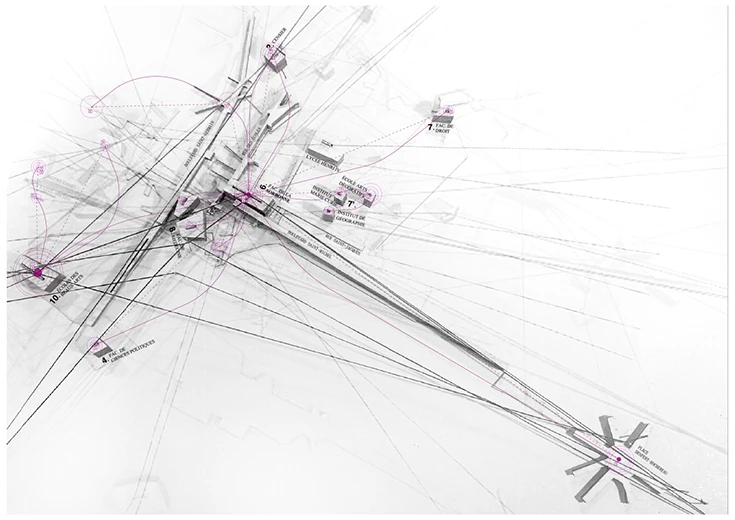
The relational field that emerged in the City of Paris during May ‘68 [#M68] was made of a dynamic myriad of invisible bonds and spatial layers of communication and empathy. The complexity of this emotional environment translated into physical, urban space through the act of taking to the streets and appropriating urban furniture, building barricades, and, most fundamentally, through the constant ap- pearance of written testimonies on the walls of Paris in the form of grafitti, spontaneous slogans or urban calligrams. Streets gave up their predominant role as transit sites in order to become dissident spaces of discussion, appropriation, transformation and debate. Normative, Euclidean space was imbued with countless layers of affectivity, social conflict, use, activity, energy, as well as the expansion of bodies in space. Because these intangible layers transform space, they interfere with the spatial response that may be provided by any architectural project. Thus, dealing with such subjective spaces within an urban environment entails the challenge of creating new unveiling devices that can unmask the interactions between emotional and physical bodies. Arguably, through the act of unmasking and revealing relational space, these could provide an insightful approach to the possibilities of the invisible in the field of contemporary architecture and urban space.
El campo relacional que se establece en la ciudad de París en #Mayo68, compone una maraña dinámica de líneas de conexión invi- sibles y ámbitos espaciales de comunicación y empatía. Este entorno complejo de relaciones emocionales se plasma en los espacios físicos de la ciudad a través de la toma de las calles y del mobiliario urbano, la construcción de barricadas, o la continua aparición de pintadas espontáneas o caligramas urbanos por la ciudad. Así, la calle abandona su papel como vía de tránsito para convertirse en espacio de disi- dencia, apropiado, de discusión y parlamento colectivo. El espacio euclídeo se transforma e imbrica con estratos intangibles de afectividad, conflicto social, uso, actividad, energía y extensión de los cuerpos en el espacio. Estas capas transforman el espacio y por tanto interfieren en la respuesta espacial que da un proyecto. Para abordar estas espacialidades subjetivas desde la perspectiva arquitectónica y urbanística contemporáneas ¿no deberíamos acaso inventar primero las herramientas que permitan desvelar y trabajar con las posibilidades de lo invisible en el campo de la arquitectura y el urbanismo?
comments powered by HyperComments






LATEST COMMENTS